
Imagine a technology so innovative yet simple that it simultaneously transforms cutting-edge research capabilities while being buildable by schoolchildren using toy bricks. This is the story of NanoJ-Fluidics, affectionately known as “Pumpy”.
The journey began in 2017 when our research team faced a fundamental challenge in microscopy – the need to precisely exchange fluids at the microscope sample while maintaining imaging continuity. Commercial solutions were prohibitively expensive, complex to operate, and largely inaccessible to most laboratories worldwide. Rather than designing yet another expensive black box, we took a radical approach – could we build a solution using components so familiar that even children could understand and assemble them?
The result was NanoJ-Fluidics (Pumpy) – an automated, precise fluid delivery system built entirely from LEGO components, controlled by open-source software. The system uses LEGO motors and gears to create syringe pumps that can deliver nanolitre-precision fluid exchange directly on microscope stages. This seemingly simple innovation unlocked entirely new experimental capabilities. Researchers could now perform complex protocols like live-to-fixed correlative imaging, sequential labelling, and multiplexed super-resolution microscopy with previously impossible precision and reproducibility.
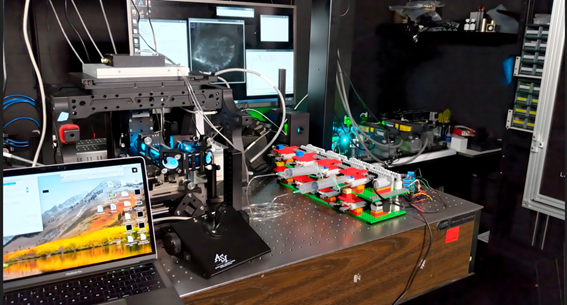
The publication of our approach in Nature Communications in 2019 garnered immediate attention, but what happened next surprised even us. Beyond transforming research capabilities in well-equipped laboratories, Pumpy catalysed a movement in democratising science and education. The core strength of our approach – using familiar LEGO components – made advanced scientific concepts accessible to students and the general public in unprecedented ways.
Working alongside Pedro Pereira, who co-invented Pumpy and now leads his own research group at ITQB NOVA studying Staphylococcus aureus intracellular infection, we witnessed how this technology enabled sophisticated experiments assisting in understanding cellular behaviour and structure at the nanoscale. Here Pumpy facilitated precise coordination between live-cell imaging, fixation, and immunolabelling – critical capabilities for understanding infection mechanisms in cells.
The educational impact quickly extended beyond research laboratories into classrooms. Workshops were developed where students could build their own scientific instruments using LEGO bricks, learning principles of fluidics, microscopy, and experimental design through hands-on engagement. The inherent familiarity of LEGO removed traditional barriers to understanding complex scientific equipment. Suddenly, the black box of scientific instrumentation became transparent, buildable, and understandable.
As word spread, particularly through social media with the #pumpy hashtag, educators worldwide began adopting these approaches. Children who might have previously seen science as abstract or inaccessible were now building functional scientific instruments with their own hands, using components they already understood. This transformation in science education represents one of Pumpy’s most profound impacts – making sophisticated science tangible and approachable for young learners.
The evolution continued as we transitioned many components from LEGO to 3D printing, maintaining the open-source philosophy while enabling more precise and customised designs. This development allowed for the creation of ever more sophisticated microscopy tools while preserving the educational value of having students understand and participate in the building process. Today, these technologies form core components of major research initiatives at ITQB NOVA, including my ERC Consolidator Grant focused on AI-driven live-cell super-resolution microscopy and the multinational RT-SuperES consortium.
Perhaps most excitingly, the RT-SuperES project now uses Pumpy-enabled techniques to bridge the worlds of live-cell imaging and small-scale proteomics at the light microscope. This capability, unimaginable before our development, allows researchers to transition seamlessly between observing dynamic cellular processes and performing detailed molecular analyses of the same cells.
The story of Pumpy exemplifies how seemingly simple innovations can catalyse profound changes across multiple domains. By reimagining scientific instrumentation as something that could be built from children’s toys, we not only transformed research capabilities but also redefined how scientific concepts could be taught and understood. The impact extends from primary school classrooms to the most advanced research laboratories, united by a common thread – the democratisation of knowledge and technology.
It turns out toy bricks can power high-end research. Pumpy shows that making science tools open, accessible (and at times fun) is a way to accelerate discovery and inspire the next generation.
Ricardo Henriques